How to create a fitness app in 2026: Custom, no-code or AI

Monica McCormick
13 min
·
I co-founded Movement (movement.so), a platform people use to launch their own fitness, coaching and community apps. Which means I've spent four years hearing what happened when people tried to build one another way first. This guide is the conversation I end up having on nearly every demo call, written down.
There are three real ways to create a fitness app in 2026: hire developers, prompt an AI builder, or build on a platform. I'll show you what each one actually costs, using real numbers from real people, and I'll tell you honestly when you shouldn't use a platform like ours.
Key Takeaways
Custom fitness app builds quoted to our customers ranged from $10,000 to get started to a $150,000 rebuild, plus ongoing maintenance.
Platform builds run free to $99/month; one coach launched hers in 48 hours.
AI builders get you 80% of the way visually; payments, sign-in and maintenance are the 20% that hurts.
You probably don't need the App Store on day one (or day 30): web app checkout fees run ~2.5% vs 15-30% store commission.
What does it actually cost to create a fitness app in 2026?
Here's the honest range, from people who got quotes. Our customers were quoted between $10,000 and $50,000 just to start a custom build, and one was quoted $150,000 for a rebuild. A platform build runs from free to $99 per month, and most people land on the $49 base plan. Even development agencies publish MVP figures of $25,000-$30,000 for custom apps and estimate annual maintenance at 15-20% of the build cost (Topflight Apps, 2026).
Caitlin Cady's story is the one I tell most often. She already had a custom app in the app stores. She'd invested around $25,000-30,000 AUD to build it and had no intention of leaving: "it was like a marriage I was stuck in," she told us. Then her developer called: the app would soon be obsolete and needed a full rebuild. The quote was $150,000 USD. Roughly six times the sticker price of the original build:
"That was far out of the realm of possibility," she said. "It felt like a blessing, because I thought, that's just not an option, so I have to find something else."
And it's not just the build. The ongoing maintenance is what catches people off guard. Caitlin's ran anywhere from $0 to $300 a month when things went well—and $1,000 to $2,500 in the months when they didn't. Even wanting to add something simple came with a bill attached.
She's not unusual. Olivia spoke to three development companies before building Live Active on Movement, including ones attached to big fitness brands. "Realistically, they were talking about a $50,000 deposit just to get the app off the ground. For me, that's just not where my business is at."Marcos at Hunger was quoted $10,000-$15,000 "just to get started." Scarlett had been with Circle for six months when they upsold her a branded app at $30,000 USD a year. And Mahesh was paying $8,000-$10,000 a month for a three-person dev team before switching.

Customer-reported quotes collected by Movement between 2024 and 2026 put custom fitness app development at $10,000-$50,000 to begin, $150,000 for a rebuild, and $1,000-$2,500 in surprise monthly maintenance, while platform-based fitness apps launch for free to $49 per month.
Route | Upfront Cost | Ongoing | Time to Launch |
|---|---|---|---|
Custom development | $10k-$50k to start (customer- reported); $150k rebuild quoted | $0-$2,500/month maintenance | Months, per our customers' accounts |
AI builder (Lovable, Replit, Bolt) | Tool subscription, plus developer help | Your time, plus dev fees when bugs appear | Days to build, ongoing upkeep |
Platform (movement.so) | Free to $99/month | 2.5% transaction fee on the base & pro plans | 48 hours to 90 days |
Sources: customer-reported quotes collected by Movement, 2024-2026; agency-published ranges (Topflight Apps, 2026).
The three ways to build a fitness app (and who each is for)
The short version: if the technology is your product, go custom. If technology is just how you deliver your product, whether that's your coaching, workouts, community or content, custom is usually the long, expensive way to get something a platform already does well.
Custom development gives you full control, and full responsibility to match. Every feature, every bug and every server bill is yours. It makes sense for truly bespoke products, like complex algorithms, logistics, anything Uber-shaped, or games. If that's you, this probably isn't your article.
AI app builders like Lovable, Replit and Bolt have opened up a new middle ground, where you can prompt your way to something real, fast. We're now seeing customers come over from these tools, and their stories follow the same pattern, so I'll share more on that below.
Platforms like ours come with the fitness infrastructure already built, from workouts and payments to community and progress tracking, so you can put your energy into shaping an app that looks and feels like your brand. (I'll name competitors too: Passion.io, Trainerize and others play here.) You give up a little bespoke flexibility, and in return the maintenance is never your problem.
AI app builders like Lovable, Replit and Bolt are the new middle path. You prompt your way to something real, fast. More on how that goes below, because we now get customers arriving from these tools and their stories have a pattern.
Platforms (like ours, and I'll name competitors too: Passion.io, Trainerize and Everfit) pre-build the fitness infrastructure, workouts, payments, community, tracking, and let you design your app on top. The trade is some bespoke flexibility for not owning the maintenance.

See how the no-code app builder works
Can you really build a fitness app with AI in 2026?
Yes, and more people are doing it than ever. That part is new. A year ago, prompting your way to a working custom app wasn't realistic for a non-technical founder. Now you can get about 80% of the way there, and because that 80% is the visual part, it feels nearly finished. The catch is that the missing 20% is payments, sign-in, account data and checkout, which are some of the most critical parts to get right because they're tied to your revenue and your members' trust.
We recently had a founder come to us who was running her community platform on Lovable, connected to Supabase, GitHub and a developer. In her words: "As bugs continue to pop up, I'm finding I don't have the time or financial bandwidth to keep investing in custom development. I want to explore whether it makes sense to switch to a platform I can manage independently."
That's the pattern we see about six months in. The build is exciting and quick, but maintaining it is neither. When a bug shows up, you don't know where to turn, so you either pay a developer or re-prompt and hope for the best.
The clearest example I've seen was a creator with a big following who recently launched a vibe-coded fitness app. It looked great, but the launch-day comments were full of people saying checkout didn't work. Imagine your biggest marketing moment of the year, and the one flow that actually makes you money is the one that's broken. That's the 20%.
So when would I point you towards an AI builder? If you're building something with truly custom logic or an internal tool, or if you have technical support (or developers) on hand and enjoy owning the stack. They can absolutely get you started but keeping things running smoothly after launch is a different story. You need a maintenance plan.
What do people misunderstand about building a fitness app?
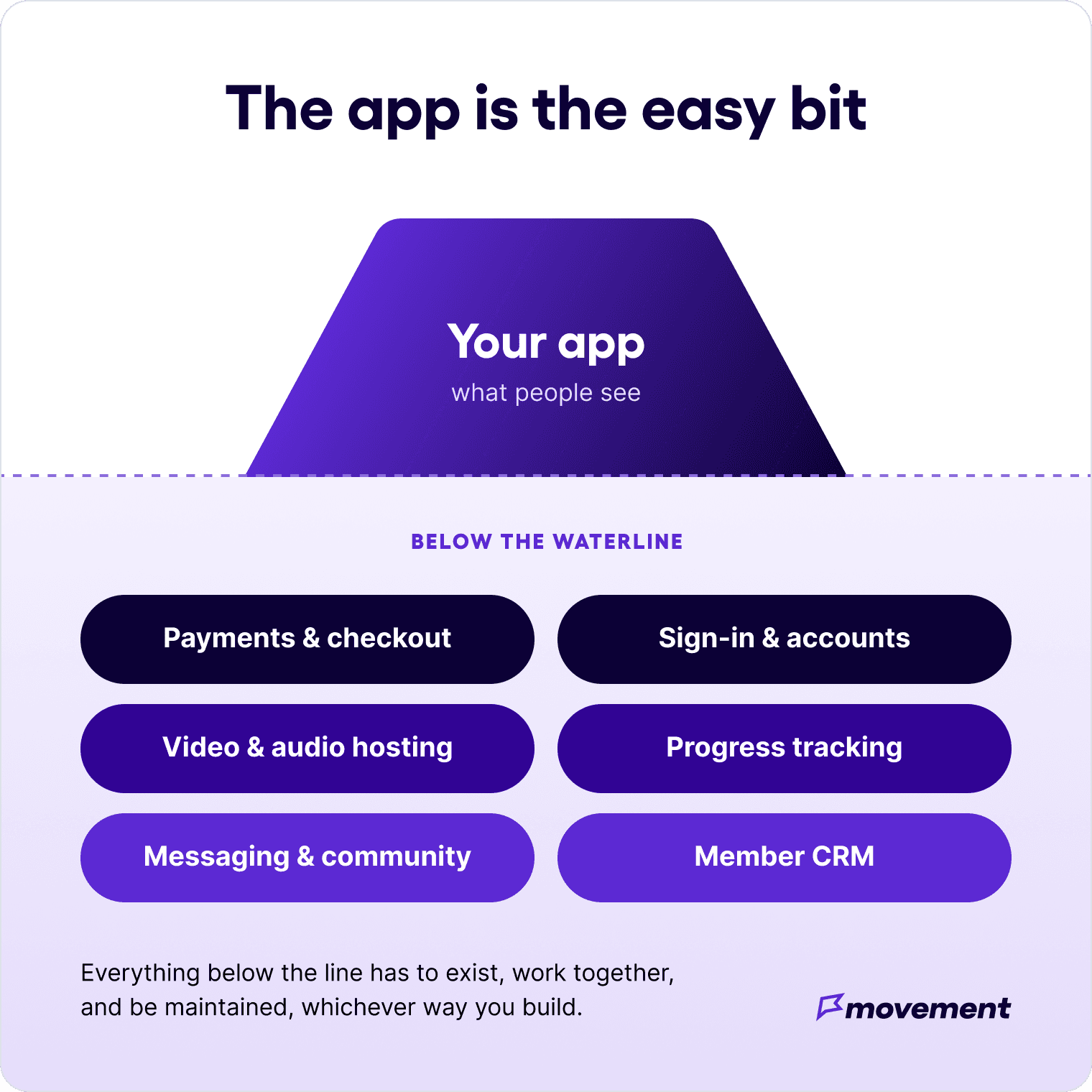
The app itself is actually the easy part. What people underestimate is all the infrastructure underneath it, because none of it shows up in a screenshot.
Every coach structures workouts a little differently, from progressions and supersets to how each week releases and how one program flows into the next. Recreating the exact experience you deliver as a coach is the real design challenge. On top of that, every piece needs to work together as one experience, including progress tracking, intake forms, payments, sign-in and messaging. Then there's the question that catches nearly everyone out: where do your videos and audio actually live, and what does it cost to host them as you grow?
Brooke, a coach who launched on Movement, described this perfectly. She'd tested the big fitness platforms and couldn't get past how focused on body image the default experience was: "The first thing people see is weight, measurements, calories and macros." Her whole method was built to avoid that as it can overwhelm and limit confidence. What she needed wasn't just an app, but control over how the app flowed, so it matched the way she actually coaches: "before Movement.so, my biggest challenges were pricing (scaling my business economically), limited control over the client-facing design, and clunky navigation that didn’t match the way I coach."
And that's really what a fitness app needs to be. Not a list of features, but your method, built into software.
How long does it take to launch a fitness app?
On a platform, it takes anywhere from 48 hours to 90 days. And what decides it is almost never the technology. It's whether your content is ready.
The 48 hours isn't hypothetical. Brooke designed, built and launched her app in two days, on a free trial, without a single demo call: "on any other platform, that process would have taken weeks or months of sales calls, onboarding and backend processing." Most people take longer, and the reason is nearly always filming. They sign up, see what's possible, and decide to reshoot everything. That's a content decision, not a software decision.
Here's what the path from signing up to launching actually looks like:
Sign up and open the builder. No call needed, you can start straight away.
Get your content ready and import it. Use what you already have where you can, since re-filming everything is the most common reason launches drag on. When you're ready, the team can help bulk import your exercises (video, audio, etc.) and meals from places like Dropbox, YouTube or Vimeo into a template you can customize.
Structure your programs. Map out your weeks, progressions and release schedule. This is where most people get stuck, so borrow from how you already deliver your coaching.
Set up payments and access. Connect Stripe and create your subscriptions and one-off products. Choose your tiers, trials and who gets access to what. If you're coming from another platform, this is also when you migrate existing members.
Launch your web app. Share the link (like a regular website) so members can save it to their home screen. It works like a downloaded app on mobile and just as well on desktop. App stores can come in later, if needed.
More on structuring your programs with the workout builder.
Do you need to be in the App Store?
Not on day one, and once you see the numbers (and learn more about the process), you'll see why. Apple's standard commission is 30%, or 15% if you're in their Small Business Program (Apple, 2026). A sale through your own web app checkout on our Base plan carries a 2.5% transaction fee. On a $50 program, that's the difference between keeping about $48.75 and keeping $42.50, or just $35 at Apple's standard rate.
If you've been wondering about this, you're not alone. It's by far the most common question people ask before launching. In our own support data, it's one of the top three topics month after month.
What surprises most people is that once a web app is saved to a phone's home screen, it looks and feels just like a native app, with your own app icon, a full-screen experience and push notifications. That's why we recommend almost everyone launches with the web app first, and the customers who've been through the app stores before are usually the most relieved to hear it.
So when are the app stores worth it? When you're at a scale where discovery and credibility really matter, or when your audience simply expects to find you there. It's a great second step, just an expensive first one.
See why you don't need the app stores to launch your fitness app →

Full breakdown of plans and transaction fees
When shouldn't you use a platform like Movement?
If you're building something like a food delivery app, ride pickups, a game, or anything that needs truly bespoke algorithms or deep custom integrations, custom development is pretty unavoidable, and a platform will only frustrate you. The same goes if what sets you apart is an interface nobody has built before.
But if you're mainly delivering or selling content, coaching, workouts, video, community or any kind of knowledge, a platform is the easiest way to launch and keep an app running. It's not that building custom is impossible, it's that maintaining custom is the part nobody budgets for. With a platform, you have a whole team of designers and developers behind the product, working on reliability and uptime around the clock.
Mahesh of MoonRise Health saw the difference firsthand. With his old team, restructuring his content took eight or nine weeks and cost around $12,000. On Movement, he "did it in three hours and it looks better." His support tickets also dropped by 70-80%.
Read how coaches made the switch, in their own words
Frequently asked questions
How much does it cost to make a fitness app?
It depends on the path you choose. Our customers who went custom reported spending anywhere from $10,000-$15,000 to get started, up to $150,000 for a rebuild. Agencies publish MVP ranges of $25,000-$30,000, plus 15-20% of that each year in maintenance (Topflight Apps, 2026). On a platform, you can start for free, with paid plans from about $49-99 per month.
Can I create a fitness app without coding?
Yes. Platforms come with payments, sign-in, progress tracking, hosting and community already built, so you're putting your app together rather than coding it. AI builders also don't require code, but you're left looking after the bugs and maintenance yourself. One of our coaches went from signing up to launching her app in 48 hours, without a single demo call.
How long does it take to build a fitness app?
The custom builds our customers described took months to launch. On a platform, it's anywhere from 48 hours to 90 days, and the biggest factor is whether your workout and video content is filmed and ready, not the software. Importing content like spreadsheets, meal plans and YouTube playlists can turn the setup work into a matter of hours.
Do fitness apps have to be in the App Store?
No. A web app saved to your phone's home screen looks and feels just like a native app, and selling through your own checkout means you avoid the 15-30% app store commission (Apple, 2026). Plus, updates to your app are instant and don't have to go back through review queues, etc. The app store launch and review process can be very time-consuming, cumbersome and inconsistent. Almost all of our customers launch with a web app, and while some add the app stores once they've grown, many of our biggest creators never do.
Can AI build a fitness app for me?
AI can build the visual 80% of an app really quickly. The other 20%, like payments, sign-in, account data and ongoing maintenance, is where AI-built apps struggle without a developer. We've had customers come to us from Lovable who loved building their app but burnt out on keeping it running.
The honest summary
There are three ways to create a fitness app in 2026. Go custom if the technology is your product and you can handle five-figure builds, six-figure rebuilds and the maintenance in between. Use an AI builder if you want to own the technical side and can handle the 20% that deals with money. Choose a platform if your product is your coaching and content, and you'd rather launch this week.
Whichever path you choose, get your content ready first, because that's what really decides your timeline.
And if you want to see what building on a platform feels like, you can try it the way Brooke did, building and launching her app in a weekend without talking to anyone. You can start building free here.